Some examples of do-calculus
|
|
|



In [1]:
from IPython.display import display, Math

import pyagrum as gum
import pyagrum.lib.notebook as gnb
import pyagrum.causal as csl
import pyagrum.causal.notebook as cslnb
S. Tikka and J. Karvanen, 2016 [CRAN]
In [2]:
bn = gum.fastBN("w->x->z->y;w->z")

bn.cpt("w")[:] = [0.7, 0.3]

bn.cpt("x")[:] = [[0.4, 0.6], [0.3, 0.7]]

bn.cpt("z")[{"w": 0, "x": 0}] = [0.2, 0.8]
bn.cpt("z")[{"w": 0, "x": 1}] = [0.1, 0.9]
bn.cpt("z")[{"w": 1, "x": 0}] = [0.9, 0.1]
bn.cpt("z")[{"w": 1, "x": 1}] = [0.5, 0.5]

bn.cpt("y")[:] = [[0.1, 0.9], [0.8, 0.2]]


d = csl.CausalModel(bn, [("lat1", ["x", "y"])])
# csl.causalImpact(d,"y",{"x":0})
cslnb.showCausalImpact(d, "y", "x", values={"x": 0})
cslnb.showCausalImpact(d, "y", "x", values={"x": 1})
$$
\begin{equation*}P( y \mid \text{do}(x)) = \sum_{w,z}{\left(\sum_{x'}{P\left(x'\mid w\right) \cdot P\left(y\mid w,x',z\right)}\right) \cdot P\left(z\mid w,x\right) \cdot P\left(w\right)}\end{equation*}
$$
Explanation : Do-calculus computations
|
|
|
|---|---|
| 0.5130 | 0.4870 |
$$
\begin{equation*}P( y \mid \text{do}(x)) = \sum_{w,z}{\left(\sum_{x'}{P\left(x'\mid w\right) \cdot P\left(y\mid w,x',z\right)}\right) \cdot P\left(z\mid w,x\right) \cdot P\left(w\right)}\end{equation*}
$$
Explanation : Do-calculus computations
|
|
|
|---|---|
| 0.6460 | 0.3540 |
Since we have the formula, let us compute by hand this intervention :
In [3]:
(((bn.cpt("x") * bn.cpt("y")).sumOut(["x"]) * bn.cpt("w") * bn.cpt("z")).sumOut(["z", "w"])).putFirst("y")
Out[3]:
|
|
| |
|---|---|---|
| 0.5130 | 0.4870 | |
| 0.6460 | 0.3540 | |
In [4]:
bn = gum.fastBN("Z1->X->Z2->Y")
d = csl.CausalModel(bn, [("L1", ["Z1", "X"]), ("L2", ["Z1", "Z2"]), ("L3", ["Z1", "Y"]), ("L4", ["Y", "X"])], True)
cslnb.showCausalImpact(d, "Y", "X", values={"X": 1})
Hedge Error: G={'Z2', 'Z1', 'X'}, G[S]={'Z2'}
Impossible
No result
Impact
Front door
In [5]:
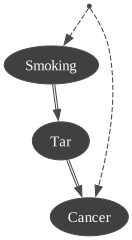
modele4 = gum.BayesNet()
modele4.add(gum.LabelizedVariable("Smoking"))
modele4.add(gum.LabelizedVariable("Cancer"))
modele4.add(gum.LabelizedVariable("Tar"))

modele4.addArc(0, 2)
modele4.addArc(2, 1)
modele4.addArc(0, 1)

# Smoking
modele4.cpt(0)[:] = [0.5, 0.5]

# Tar
modele4.cpt(2)[{"Smoking": 0}] = [0.4, 0.6]
modele4.cpt(2)[{"Smoking": 1}] = [0.3, 0.6]

# Cancer
modele4.cpt(1)[{"Smoking": 0, "Tar": 0}] = [0.1, 0.9]  # No Drug, Male -> healed in 0.8 of cases
modele4.cpt(1)[{"Smoking": 0, "Tar": 1}] = [0.15, 0.85]  # No Drug, Female -> healed in 0.4 of cases
modele4.cpt(1)[{"Smoking": 1, "Tar": 0}] = [0.2, 0.8]  # Drug, Male -> healed 0.7 of cases
modele4.cpt(1)[{"Smoking": 1, "Tar": 1}] = [0.25, 0.75]

d4 = csl.CausalModel(modele4, [("Genotype", ["Smoking", "Cancer"])], False)
cslnb.showCausalModel(d4)
In [6]:
try:
  a = csl.doCalculusWithObservation(d4, "Cancer", {"Smoking"})
except csl.HedgeException as h:
  print(h.message)
In [7]:
display(Math(a.toLatex()))
$\displaystyle P( Cancer \mid \text{do}(Smoking)) = \sum_{Tar}{P\left(Tar\mid Smoking\right) \cdot \left(\sum_{Smoking'}{P\left(Smoking'\right) \cdot P\left(Cancer\mid Smoking',Tar\right)}\right)}$
In [8]:
try:
  adjj = a.eval()
except csl.UnidentifiableException as u:
  print(u.message)

print(adjj)
      ||  Cancer           |
Smokin||0        |1        |
------||---------|---------|
0     || 0.1774  | 0.8226  |
1     || 0.1626  | 0.7374  |
In [9]:
formula, adj, exp = csl.causalImpact(d4, "Cancer", "Smoking", values={"Smoking": 0})
In [10]:
display(Math(formula.toLatex()))
adj
$\displaystyle P( Cancer \mid \text{do}(Smoking)) = \sum_{Tar}{P\left(Tar\mid Smoking\right) \cdot \left(\sum_{Smoking'}{P\left(Cancer\mid Smoking',Tar\right) \cdot P\left(Smoking'\right)}\right)}$
Out[10]:
|
|
|
|---|---|
| 0.1774 | 0.8226 |
## Last example from R
In [11]:
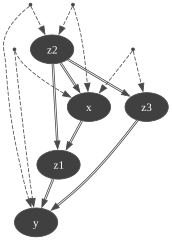
m = gum.fastBN("z2->x->z1->y;z2->z1;z2->z3->y")

m.cpt("z2")[:] = [0.5, 0.5]
m.cpt("x")[:] = [
  [0.4, 0.6],  # z2=0
  [0.4, 0.6],
]  # z2=1
m.cpt("z3")[:] = [
  [0.3, 0.7],  # z2=0
  [0.3, 0.7],
]  # z2=1
m.cpt("z1")[{"z2": 0, "x": 0}] = [0.2, 0.8]
m.cpt("z1")[{"z2": 0, "x": 1}] = [0.25, 0.75]
m.cpt("z1")[{"z2": 1, "x": 0}] = [0.1, 0.9]
m.cpt("z1")[{"z2": 1, "x": 1}] = [0.15, 0.85]

m.cpt("y")[{"z1": 0, "z3": 0}] = [0.5, 0.5]
m.cpt("y")[{"z1": 0, "z3": 1}] = [0.45, 0.55]
m.cpt("y")[{"z1": 1, "z3": 0}] = [0.4, 0.6]
m.cpt("y")[{"z1": 1, "z3": 1}] = [0.35, 0.65]


d = csl.CausalModel(m, [("X-Z2", ["x", "z2"]), ("X-Z3", ["x", "z3"]), ("X-Y", ["x", "y"]), ("Y-Z2", ["y", "z2"])], True)

cslnb.showCausalModel(d)
In [12]:
try:
  formula, result, msg = csl.causalImpact(d, on={"y", "z2", "z1", "z3"}, doing={"x"})
except csl.HedgeException as h:
  print(h.message)

print(msg)
display(Math(formula.toLatex()))
Do-calculus computations
$\displaystyle P( z3,z2,z1,y \mid \text{do}(x)) = P\left(z3\mid z2\right) \cdot P\left(z1\mid x,z2\right) \cdot P\left(z2\right) \cdot \frac {\sum_{x'}{P\left(x'\mid z2\right) \cdot P\left(z2\right) \cdot P\left(z3\mid x',z2\right) \cdot P\left(y\mid x',z1,z2,z3\right)}}{\sum_{x',y'}{P\left(x'\mid z2\right) \cdot P\left(z2\right) \cdot P\left(z3\mid x',z2\right) \cdot P\left(y'\mid x',z1,z2,z3\right)}}$
In [13]:
# computation for this formula directly in pyAgrum
f1 = m.cpt("x") * m.cpt("z2") * m.cpt("z3") * m.cpt("y")
f2 = f1.sumOut(["x"])
f3 = f1.sumOut(["x", "y"])
f4 = f2 / f3
pyResult = m.cpt("z3") * m.cpt("z1") * m.cpt("z2") * f4
In [14]:
# computation for this formula directly by creating the causal AST
a = csl.ASTposteriorProba(m, {"z1"}, {"x", "z2"})
b = csl.ASTposteriorProba(m, {"y", "z3"}, {"x", "z1", "z2"})
c = csl.ASTjointProba(["x", "z2"])
correct = csl.ASTmult(a, csl.ASTsum(["x"], csl.ASTmult(b, c)))

print("According to [ref], the result should be :")
display(Math(correct.toLatex()))
According to [ref], the result should be :
$\displaystyle P\left(z1\mid x,z2\right) \cdot \left(\sum_{x}{P\left(y,z3\mid z1,z2\right) \cdot P\left(x,z2\right)}\right)$
In [15]:
# computation for that formula
ie = gum.LazyPropagation(m)
refResult = (ie.evidenceJointImpact(["y", "z3"], ["x", "z1", "z2"]) * ie.evidenceJointImpact(["x", "z2"], [])).sumOut(
  ["x"]
) * m.cpt("z1")
In [16]:
print(
  "Maximum error between these 3 versions : {}".format(
    max((refResult - pyResult).abs().max(), (refResult - result).abs().max(), (pyResult - result).new_abs().max())
  )
)
Maximum error between these 3 versions : 5.551115123125783e-17
Unidentifiabilty
In [17]:
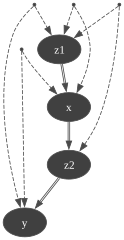
m1 = gum.fastBN("z1->x->z2->y")

cdg = csl.CausalModel(
  m1, [("Z1−X", ["z1", "x"]), ("Z1-Y", ["z1", "y"]), ("Z1-Z1", ["z1", "z2"]), ("X−Y", ["x", "y"])], True
)
cslnb.showCausalModel(cdg)
In [18]:
err = cslnb.showCausalImpact(cdg, "y", "x", values={"x": 0})
Hedge Error: G={'x', 'z2', 'z1'}, G[S]={'z2'}
Impossible
No result
Impact
another one
In [19]:
# EXEMPLE PAGE 17 : http://ftp.cs.ucla.edu/pub/stat_ser/r350.pdf


m1 = gum.BayesNet()
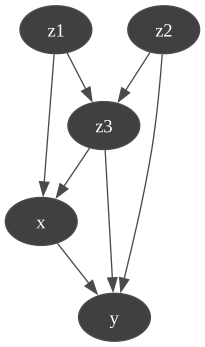
m1.add(gum.LabelizedVariable("x"))
m1.add(gum.LabelizedVariable("y"))
m1.add(gum.LabelizedVariable("z1"))
m1.add(gum.LabelizedVariable("z2"))
m1.add(gum.LabelizedVariable("z3"))

m1.addArc(2, 4)
m1.addArc(2, 0)
m1.addArc(3, 4)
m1.addArc(3, 1)
m1.addArc(4, 1)
m1.addArc(4, 0)
m1.addArc(0, 1)

gnb.showBN(m1)
d = csl.CausalModel(m1)
In [20]:
display(Math(csl.identifyingIntervention(d, {"z1", "z2", "z3", "y"}, {"x"}).toLatex()))
$\displaystyle P\left(z3\mid z1,z2\right) \cdot P\left(z2\right) \cdot P\left(z1\right) \cdot P\left(y\mid x,z2,z3\right)$
In [21]:
display(Math(csl.identifyingIntervention(d, {"y"}, {"x"}).toLatex()))
$\displaystyle \sum_{z1,z2,z3}{P\left(z3\mid z1,z2\right) \cdot P\left(z2\right) \cdot P\left(z1\right) \cdot P\left(y\mid x,z2,z3\right)}$
In [22]:
display(Math(csl.identifyingIntervention(d, {"z1", "z3", "y"}, {"x", "z2"}).toLatex()))
$\displaystyle P\left(z3\mid z1,z2\right) \cdot P\left(z1\right) \cdot P\left(y\mid x,z2,z3\right)$
In [23]:
display(Math(csl.identifyingIntervention(d, {"y"}, {"x", "z2"}).toLatex()))
$\displaystyle \sum_{z1,z3}{P\left(z3\mid z1,z2\right) \cdot P\left(z1\right) \cdot P\left(y\mid x,z2,z3\right)}$
Other example
In [24]:
# http://www.stats.ox.ac.uk/~lienart/gml15_causalinference.html

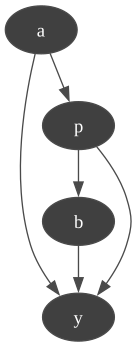
m1 = gum.BayesNet()
m1.add(gum.LabelizedVariable("a"))
m1.add(gum.LabelizedVariable("p"))
m1.add(gum.LabelizedVariable("b"))
m1.add(gum.LabelizedVariable("y"))

m1.addArc(0, 1)
m1.addArc(1, 2)
m1.addArc(0, 3)
m1.addArc(1, 3)
m1.addArc(2, 3)
gnb.showBN(m1)
d = csl.CausalModel(m1)
In [25]:
display(Math(csl.identifyingIntervention(d, {"y"}, {"a", "b"}).toLatex()))
$\displaystyle \sum_{p}{P\left(y\mid a,b,p\right) \cdot P\left(p\mid a\right)}$
example f
In [26]:
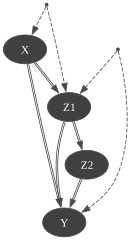
# https://cse.sc.edu/~mgv/talks/AIM2010.ppt , example (f)

m1 = gum.BayesNet()
m1.add(gum.LabelizedVariable("X"))
m1.add(gum.LabelizedVariable("Y"))
m1.add(gum.LabelizedVariable("Z1"))
m1.add(gum.LabelizedVariable("Z2"))

m1.addArc(0, 1)
m1.addArc(0, 2)
m1.addArc(2, 3)
m1.addArc(3, 1)
m1.addArc(2, 1)
d = csl.CausalModel(m1, [("l1", ["X", "Z1"]), ("l2", ["Y", "Z1"])], True)
cslnb.showCausalModel(d)
In [27]:
try:
  display(Math(csl.identifyingIntervention(d, {"Y"}, {"X"}).toLatex()))
except csl.HedgeException as e:
  print("Hedge exception : {}".format(e))
Hedge exception : Hedge Error: G={'Z1', 'X', 'Y'}, G[S]={'Z1', 'Y'}
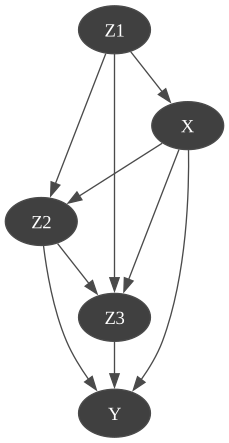
Example [Pearl,2009] Causality, p66
In [28]:
bn = gum.fastBN("Z1->Z2->Z3->Y<-X->Z2;Z2->Y;Z1->X->Z3<-Z1")
gnb.showBN(bn)
In [29]:
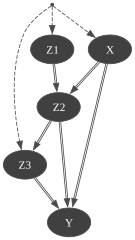
c = csl.CausalModel(bn, [("Z0", ("X", "Z1", "Z3"))], False)
cslnb.showCausalModel(c)
In [30]:
formula, impact, explanation = csl.causalImpact(c, "Y", "X")
cslnb.showCausalImpact(c, "Y", "X")
$$
\begin{equation*}P( Y \mid \text{do}(X)) = \sum_{Z1,Z2,Z3}{P\left(Y\mid X,Z2,Z3\right) \cdot P\left(Z2\mid X,Z1\right) \cdot \left(\sum_{X'}{P\left(Z1\right) \cdot P\left(Z3\mid X',Z1,Z2\right) \cdot P\left(X'\mid Z1\right)}\right)}\end{equation*}
$$
Explanation : Do-calculus computations
|
|
| |
|---|---|---|
| 0.5797 | 0.4203 | |
| 0.5521 | 0.4479 | |