Learning and causality
|
|
|



In [1]:
import pyagrum as gum
import pyagrum.lib.notebook as gnb
Model
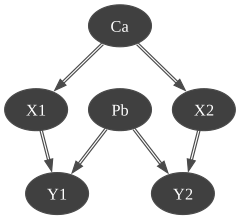
Let’s assume a process \(X_1\rightarrow Y_1\) with a control on \(X_1\) by \(C_a\) and a parameter \(P_b\) on \(Y_1\).
In [2]:
bn = gum.fastBN("Ca->X1->Y1<-Pb")
bn.cpt("Ca").fillWith([0.8, 0.2])
bn.cpt("Pb").fillWith([0.3, 0.7])

bn.cpt("X1")[:] = [[0.9, 0.1], [0.1, 0.9]]

bn.cpt("Y1")[{"X1": 0, "Pb": 0}] = [0.8, 0.2]
bn.cpt("Y1")[{"X1": 1, "Pb": 0}] = [0.2, 0.8]
bn.cpt("Y1")[{"X1": 0, "Pb": 1}] = [0.6, 0.4]
bn.cpt("Y1")[{"X1": 1, "Pb": 1}] = [0.4, 0.6]

gnb.flow.row(bn, *[bn.cpt(x) for x in bn.nodes()])
|
|
|
|---|---|
| 0.8000 | 0.2000 |
|
|
| |
|---|---|---|
| 0.9000 | 0.1000 | |
| 0.1000 | 0.9000 | |
|
|
| ||
|---|---|---|---|
|
| 0.8000 | 0.2000 | |
| 0.2000 | 0.8000 | ||
|
| 0.6000 | 0.4000 | |
| 0.4000 | 0.6000 | ||
|
|
|
|---|---|
| 0.3000 | 0.7000 |
Actually the process is duplicated in the system but the control \(C_a\) and the parameter \(P_b\) are shared.
In [3]:
bn.add("X2", 2)
bn.add("Y2", 2)
bn.addArc("X2", "Y2")
bn.addArc("Ca", "X2")
bn.addArc("Pb", "Y2")

bn.cpt("X2").fillWith(bn.cpt("X1"), ["X1", "Ca"])  # copy cpt(X1) with the translation X2<-X1,Ca<-Ca
bn.cpt("Y2").fillWith(bn.cpt("Y1"), ["Y1", "X1", "Pb"])  # copy cpt(Y1) with translation Y2<-Y1,X2<-X1,Pb<-Pb

gnb.flow.row(bn, bn.cpt("X2"), bn.cpt("Y2"))
|
|
| |
|---|---|---|
| 0.9000 | 0.1000 | |
| 0.1000 | 0.9000 | |
|
|
| ||
|---|---|---|---|
|
| 0.8000 | 0.2000 | |
| 0.2000 | 0.8000 | ||
|
| 0.6000 | 0.4000 | |
| 0.4000 | 0.6000 | ||
Simulation of the data
The process is partially observed : the control has been taken into account. However the parameter has not been identified and therefore is not collected.
In [4]:
# the base will be saved in completeData="out/complete_data.csv", observedData="out/observed_data.csv"

completeData = "out/complete_data.csv"
observedData = "out/observed_data.csv"

# generating complete date with pyAgrum
size = 35000
# gum.generateSample(bn,5000,"data.csv",random_order=True)
generator = gum.BNDatabaseGenerator(bn)
generator.setRandomVarOrder()
generator.drawSamples(size)
generator.toCSV(completeData)
In [5]:
# selecting some variables using pandas
import pandas as pd

f = pd.read_csv(completeData)
keep_col = ["X1", "Y1", "X2", "Y2", "Ca"]  # Pb is removed
new_f = f[keep_col]
new_f.to_csv(observedData, index=False)
We will use now a database fixed_observed_data.csv. While both databases originate from the same process (the cell above), the use of fixed_observed_data.csv instead of observed_data.csv is made to guarantee a deterministic and stable behavior for the rest of the notebook.
In [6]:
fixedObsData = "res/fixed_observed_data.csv"
statistical learning
Using a classical statistical learning method, one can approximate a model from the observed data.
In [7]:
learner = gum.BNLearner(fixedObsData)
learner.useGreedyHillClimbing()
bn2 = learner.learnBN()
bn2
Out[7]:
Evaluating the impact of \(X2\) on \(Y1\)
Using the database, a question for the user is to evaluate the impact of the value of \(X2\) on \(Y1\).
In [8]:
target = "Y1"
evs = "X2"
ie = gum.LazyPropagation(bn)
ie2 = gum.LazyPropagation(bn2)
p1 = ie.evidenceImpact(target, [evs])
p2 = gum.Tensor(p1).fillWith(ie2.evidenceImpact(target, [evs]), [target, evs])
errs = (p1 - p2) / p1
quaderr1 = (errs * errs).sum()
gnb.flow.row(
  p1,
  p2,
  errs,
  rf"$${100 * quaderr1:3.5f}\%$$",
  captions=["in original model", "in learned model", "relative errors", "quadratic relative error"],
)
|
|
| |
|---|---|---|
| 0.6211 | 0.3789 | |
| 0.4508 | 0.5492 | |
|
|
| |
|---|---|---|
| 0.6183 | 0.3817 | |
| 0.4415 | 0.5585 | |
|
|
| |
|---|---|---|
| 0.0044 | -0.0072 | |
| 0.0205 | -0.0168 | |
Evaluating the causal impact of \(X2\) on \(Y1\) with the learned model
The statistician notes that the change wanted by the user to apply on \(X_2\) is not an observation but rather an intervention.
In [9]:
import pyagrum.causal as csl
import pyagrum.causal.notebook as cslnb

model = csl.CausalModel(bn)
model2 = csl.CausalModel(bn2)
In [10]:
cslnb.showCausalModel(model)
In [11]:
gum.config["notebook", "graph_format"] = "svg"
cslnb.showCausalImpact(model, on=target, doing={evs})
cslnb.showCausalImpact(model2, on=target, doing={evs})
|
|
|
|---|---|
| 0.5768 | 0.4232 |
|
|
| |
|---|---|---|
| 0.5743 | 0.4257 | |
| 0.5628 | 0.4372 | |
Unfortunately, due to the fact that \(P_a\) is not learned, the computation of the causal impact still is imprecise.
In [12]:
_, impact1, _ = csl.causalImpact(model, on=target, doing={evs})
_, impact2orig, _ = csl.causalImpact(model2, on=target, doing={evs})

impact2 = gum.Tensor(p2).fillWith(impact2orig, ["Y1", "X2"])
errs = (impact1 - impact2) / impact1
quaderr2 = (errs * errs).sum()
gnb.flow.row(
  impact1,
  impact2,
  errs,
  rf"$${100 * quaderr2:3.5f}\%$$",
  captions=[
    r"$P( Y_1 \mid \hookrightarrow X_2)$ <br/>in original model",
    r"$P( Y_1 \mid \hookrightarrow X_2)$  <br/>in learned model",
    " <br/>relative errors",
    " <br/>quadratic relative error",
  ],
)
|
|
|
|---|---|
| 0.5768 | 0.4232 |
in original model
|
|
| |
|---|---|---|
| 0.5743 | 0.4257 | |
| 0.5628 | 0.4372 | |
in learned model
|
|
| |
|---|---|---|
| 0.0044 | -0.0060 | |
| 0.0243 | -0.0331 | |
relative errors
quadratic relative error
Just to be certain, we can verify that in the original model, \(P( Y_1 \mid \hookrightarrow X_2)=P(Y_1)\)
In [13]:
gnb.flow.row(
  impact1,
  ie.evidenceImpact(target, []),
  captions=[r"$P( Y_1 \mid \hookrightarrow X_2)$ <br/>in the original model", "$P(Y_1)$ <br/>in the original model"],
)
|
|
|
|---|---|
| 0.5768 | 0.4232 |
in the original model
|
|
|
|---|---|
| 0.5768 | 0.4232 |
in the original model
Causal learning and causal impact
Some learning algorthims such as MIIC (Verny et al., 2017) aim to find the trace of latent variables in the data !
In [14]:
learner = gum.BNLearner(fixedObsData)
learner.useMIIC()
bn3 = learner.learnBN()
In [15]:
gnb.flow.row(
  bn,
  bn3,
  f"$${[(bn3.variable(i).name(), bn3.variable(j).name()) for (i, j) in learner.latentVariables()]}$$",
  captions=["original model", "learned model", "Latent variables found"],
)
A latent variable (common cause) has been found in the data betwenn \(Y1\) and \(Y2\) !
Therefore we can build a causal model taking into account this latent variable found by MIIC.
In [16]:
model3 = csl.CausalModel(bn2, [("L1", ("Y1", "Y2"))])
cslnb.showCausalImpact(model3, target, {evs})
|
|
|
|---|---|
| 0.5725 | 0.4275 |
Then at least, the statistician can say that \(X_2\) has no impact on \(Y_1\) from the data. The error is just due to the approximation of the parameters in the database.
In [17]:
_, impact1, _ = csl.causalImpact(model, on=target, doing={evs})
_, impact3orig, _ = csl.causalImpact(model3, on=target, doing={evs})

impact3 = gum.Tensor(impact1).fillWith(impact3orig, ["Y1"])
errs = (impact1 - impact3) / impact1
quaderr3 = (errs * errs).sum()
gnb.flow.row(
  impact1,
  impact3,
  errs,
  rf"$${100 * quaderr3:3.5f}\%$$",
  captions=["in original model", "in learned model", "relative errors", "quadratic relative error"],
)
|
|
|
|---|---|
| 0.5768 | 0.4232 |
|
|
|
|---|---|
| 0.5725 | 0.4275 |
|
|
|
|---|---|
| 0.0075 | -0.0102 |
In [18]:
print("In conclusion :")
print(rf"- Error with spurious structure and classical inference : {100 * quaderr1:3.5f}%")
print(rf"- Error with spurious structure and do-calculus : {100 * quaderr2:3.5f}%")
print(rf"- Error with correct causal structure and do-calculus : {100 * quaderr3:3.5f}%")
In conclusion :
- Error with spurious structure and classical inference : 0.07722%
- Error with spurious structure and do-calculus : 0.17362%
- Error with correct causal structure and do-calculus : 0.01588%
In [ ]: